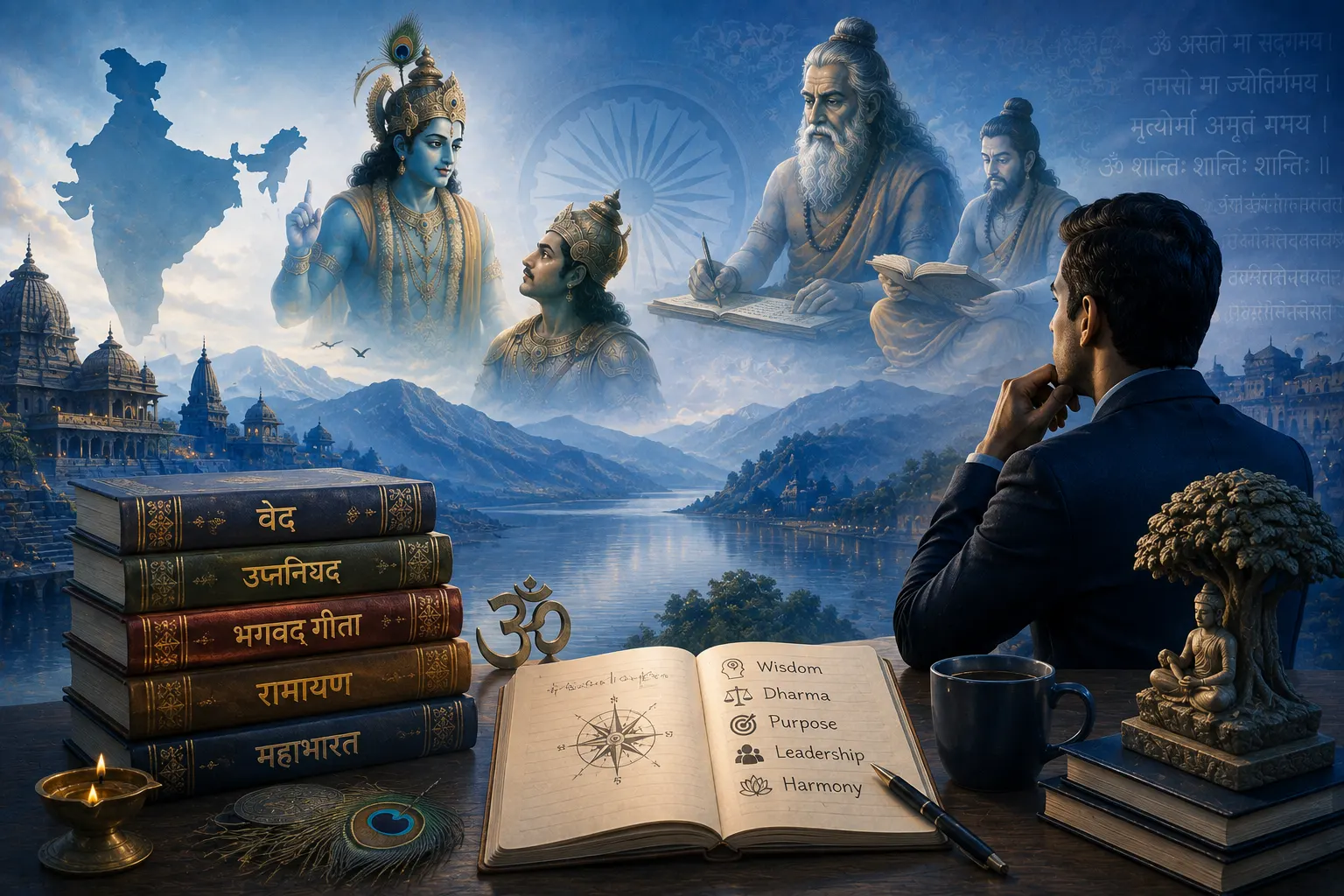
For thousands of years, the civilization of Bharat (India) has been guided not merely by kingdoms, rulers, or political systems, but by an extraordinary collection of scriptures that have shaped its philosophy, ethics, spirituality, education, governance, family values, and way of life.
These texts are not simply religious books. They are repositories of knowledge, human psychology, leadership, morality, science, philosophy, and the eternal search for truth.
Even after thousands of years, millions of people across the world continue to read, study, debate, and draw inspiration from these timeless works.
If you are new to Indian civilization, this guide will help you understand the most important scriptures and why they continue to matter.
1. The Vedas – The Foundation of Indian Civilization
The Vedas are the oldest known scriptures of India and among the oldest surviving literary works in human history. Most scholars date their composition to at least 3,000–3,500 years ago, with the oral traditions extending even further back.
The word “Veda” means “knowledge.”
Rather than being a single book, the Vedas are a vast collection of wisdom preserved through an extraordinary oral tradition for centuries before being written down.
The four Vedas are:
- Rig Veda – Hymns dedicated to various deities and the forces of nature.
- Yajur Veda – Rituals, ceremonies, and sacrificial procedures.
- Sama Veda – Musical chants and melodies used in worship.
- Atharva Veda – Knowledge related to daily life, healing, philosophy, society, and practical wisdom.
The Vedas explore questions such as:
- What is the universe?
- Who are we?
- What is consciousness?
- What is truth?
- How should society function?
- What is the relationship between humanity and nature?
The Vedas became the foundation upon which much of Indian philosophy, culture, spirituality, and education evolved.
2. The Upanishads – The Philosophy of Self-Realization
The Upanishads are philosophical texts that form the concluding portion of the Vedas and are therefore often called Vedanta (“the end or culmination of the Vedas”).
If the Vedas ask questions, the Upanishads seek to answer them.
Their central teachings revolve around:
- The nature of the Self (Atman)
- The ultimate reality (Brahman)
- Consciousness
- Meditation
- Liberation (Moksha)
- The purpose of human life
One of their most profound insights is that the individual self and the universal reality are deeply connected, inspiring seekers to look inward for truth.
Many of the world’s greatest philosophers, scientists, and spiritual thinkers have admired the Upanishads for their depth and universality.
3. The Ramayana – The Ideal Life
The Ramayana, traditionally attributed to the sage Valmiki, is one of the greatest epics ever written.
It narrates the life of Lord Rama, the prince of Ayodhya, who is regarded as the embodiment of righteousness (Dharma).
The story follows Rama’s exile, the devotion of Sita, the loyalty of Lakshmana, the unmatched service of Hanuman, and the battle against Ravana, the powerful king of Lanka.
However, the Ramayana is much more than a tale of good defeating evil.
It explores:
- Duty over personal comfort
- Leadership with integrity
- Family values
- Sacrifice
- Loyalty
- Courage
- Humility
- Justice
Each major character represents different human qualities and moral dilemmas, making the Ramayana an enduring guide to ethical living.
4. The Mahabharata – The Epic of Humanity
The Mahabharata, attributed to Ved Vyasa, is the longest epic ever composed.
It contains over 100,000 verses and is far more than the story of the Kurukshetra War.
It is a vast encyclopedia of human life.
Within its pages are discussions on:
- Politics
- Statecraft
- Economics
- Ethics
- Family conflicts
- Justice
- Leadership
- Diplomacy
- Psychology
- Spirituality
The central conflict between the Pandavas and the Kauravas represents the eternal struggle between righteousness and selfishness that exists within individuals and societies.
A famous saying about the Mahabharata captures its breadth:
“Whatever is found here may be found elsewhere; what is not found here cannot be found anywhere.”
Whether taken literally or poetically, it reflects the epic’s extraordinary scope.
5. The Bhagavad Gita – A Guide for Every Human Being
The Bhagavad Gita is one of the most celebrated philosophical works in the world.
It forms a section of the Mahabharata and presents a dialogue between Lord Krishna and the warrior Arjuna on the battlefield of Kurukshetra.
As Arjuna struggles with doubt, fear, and moral confusion, Krishna explains profound principles of life.
The Gita discusses:
- Duty (Dharma)
- Action without attachment to results (Karma Yoga)
- Knowledge (Jnana Yoga)
- Devotion (Bhakti Yoga)
- Self-discipline
- Leadership
- Decision-making
- Inner peace
- Purpose
The Bhagavad Gita teaches that true success lies in performing one’s responsibilities with sincerity, wisdom, and balance, without being enslaved by outcomes.
Because of its universal themes, it is studied by spiritual seekers, leaders, scholars, entrepreneurs, and professionals around the world.
6. The Puranas – Preserving Culture Through Stories
The Puranas are a large collection of ancient texts that preserve the history, traditions, cosmology, genealogies, and sacred stories of India.
There are traditionally 18 Mahapuranas along with several Upapuranas.
Some of the best-known include:
- Vishnu Purana
- Shiva Purana
- Bhagavata Purana
- Markandeya Purana
- Skanda Purana
The Puranas use engaging narratives to communicate philosophical and ethical ideas, making profound concepts accessible to people of all ages.
They have played a significant role in preserving festivals, pilgrimage traditions, temple culture, and regional histories across Bharat.
Why These Scriptures Still Matter
Thousands of years have passed, yet these works remain remarkably relevant because they address questions that every generation faces:
- How should we live?
- What is the right thing to do?
- What is success?
- What makes a good leader?
- How should families function?
- How can society remain just?
- What is the purpose of life?
- How can one find inner peace?
Rather than offering rigid answers, these scriptures encourage thoughtful reflection, ethical conduct, self-improvement, and a lifelong pursuit of wisdom.
Their Influence Beyond Religion
The impact of these texts extends far beyond spirituality.
They have shaped:
- Indian philosophy
- Literature
- Classical music
- Dance
- Theatre
- Sculpture
- Architecture
- Governance
- Education
- Yoga
- Ayurveda
- Ethics
- Leadership thought
Their stories, ideas, and values continue to inspire artists, scholars, scientists, philosophers, business leaders, and millions of ordinary people across the globe.
A Living Heritage
The greatness of Bharat does not rest only in its ancient monuments or historical kingdoms. It also lies in a continuous tradition of inquiry, reflection, and wisdom preserved through these extraordinary scriptures.
The Vedas laid the foundation of knowledge. The Upanishads explored the deepest questions of existence. The Ramayana demonstrated the ideals of righteous living. The Mahabharata examined the complexities of human nature and society. The Bhagavad Gita offered timeless guidance for action and inner balance. The Puranas preserved India’s cultural memory through inspiring narratives.
Together, they form one of humanity’s richest intellectual and spiritual inheritances—a legacy that continues to illuminate minds and hearts across generations.
Whether one approaches them as sacred texts, philosophical works, historical traditions, or literary masterpieces, these scriptures remain an invitation to learn, reflect, and discover deeper dimensions of life.