Most business owners measure success through revenue, profit, market share, or customer growth. While these numbers are important, I believe they are merely outcomes—not the real reason behind success.
Over the years, after interacting with thousands of businesses across different industries, I have observed an interesting pattern.
Every successful business possesses at least one form of goodness.
It may not be the best company in every aspect. It may not have the biggest marketing budget. It may not even have the best product in the market.
Yet, there is always something exceptionally good about it.
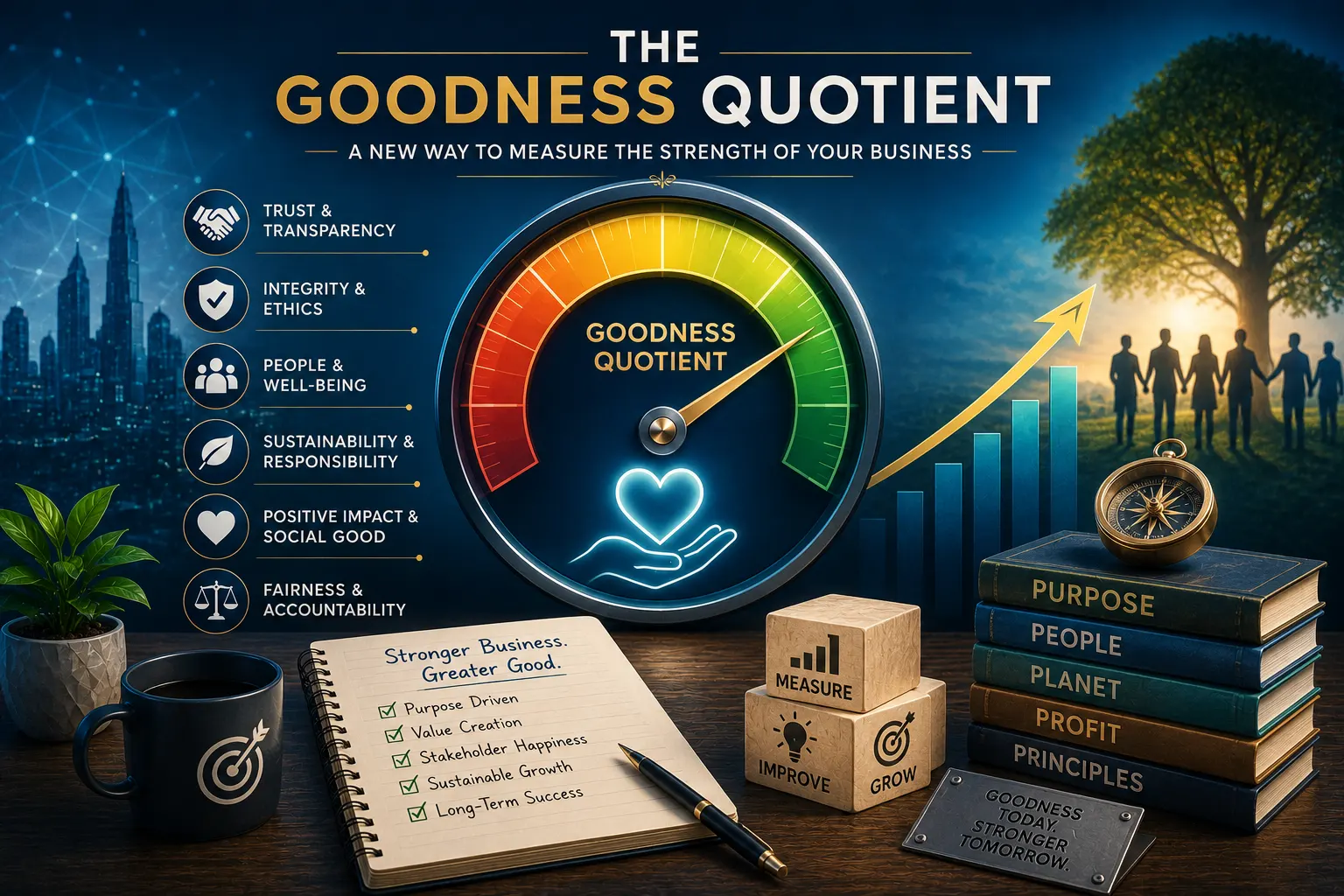
I call this the Goodness Quotient (GQ) of a business.
What is the Goodness Quotient?
The Goodness Quotient is the sum of all the areas in which a business is genuinely strong.
Every company has multiple dimensions. Some excel in one, others in many. The higher the number of areas in which your business is truly “good,” the stronger your long-term competitive advantage becomes.
Interestingly, being outstanding in just one critical area can sometimes compensate for weaknesses elsewhere.
That is why businesses with average branding become market leaders, while beautifully marketed companies disappear within a few years.
Success is rarely accidental.
It is usually powered by one or more forms of goodness.
1. Product Goodness
This is probably the easiest one to understand.
If your product solves a real problem better than everyone else, customers forgive many shortcomings.
Your office may be ordinary.
Your website may be average.
Your branding may not be impressive.
But if customers genuinely love your product, they will continue recommending it.
History has shown that superior products often build loyal communities without expensive advertising.
Product excellence creates trust.
Trust creates repeat business.
Repeat business creates brands.
2. Service Goodness
Many businesses don’t have revolutionary products.
Instead, they win because they deliver an unforgettable experience.
Fast responses.
Timely delivery.
Helpful staff.
Problem-solving attitude.
After-sales support.
Customers often remember how you made them feel more than what you sold.
A company with exceptional service can outperform competitors offering technically better products.
3. Team Goodness
Great businesses are rarely built by great founders alone.
They are built by great teams.
A motivated team solves problems before customers notice them.
They innovate.
They care.
They protect the company’s reputation.
Even an average business model can produce extraordinary results when executed by extraordinary people.
This is why investing in recruitment, training, culture, and leadership is never an expense.
It is an investment in your Goodness Quotient.
4. Founder Goodness
The founder sets the emotional temperature of the organization.
Their vision.
Integrity.
Decision-making.
Consistency.
Energy.
Humility.
Learning attitude.
All of these gradually become part of the company’s DNA.
Employees may join for salaries, but they stay because they believe in leadership.
Investors invest in founders before they invest in products.
Customers trust brands led by trustworthy people.
The founder’s character quietly becomes the company’s biggest brand asset.
5. Financial Goodness
Many brilliant ideas fail because they run out of cash.
Financial strength gives businesses something extremely valuable:
Time.
Time to improve products.
Time to experiment.
Time to make mistakes.
Time to build trust.
Companies with healthy finances don’t panic during market downturns.
They don’t compromise quality.
They don’t make desperate decisions.
Financial goodness creates stability.
Stability creates confidence.
Confidence allows innovation.
6. Innovation Goodness
Some companies constantly reinvent themselves.
They don’t wait for competitors.
They don’t wait for disruption.
They become the disruptors.
Innovation is not only about technology.
It can be about pricing.
Packaging.
Customer experience.
Processes.
Distribution.
Business models.
Organizations that innovate continuously rarely become irrelevant.
7. Brand Goodness
Some brands simply feel trustworthy.
Before purchasing, customers already believe they are making the right choice.
That confidence doesn’t happen overnight.
It is earned through consistency.
Consistent quality.
Consistent communication.
Consistent values.
Consistent customer experience.
A trusted brand reduces the customer’s fear of making the wrong decision.
8. Culture Goodness
Culture is what people do when nobody is watching.
It determines how employees behave.
How leaders make decisions.
How conflicts are resolved.
How customers are treated.
Strong cultures produce consistent organizations.
Weak cultures produce unpredictable ones.
Culture silently influences every business outcome.
9. Relationship Goodness
Businesses do not grow alone.
They grow through relationships.
Customers.
Suppliers.
Employees.
Partners.
Distributors.
Investors.
Government authorities.
Communities.
Businesses that genuinely nurture relationships receive opportunities that money cannot buy.
Many large contracts are won not because of the lowest price, but because of the highest trust.
10. Process Goodness
Some organizations function smoothly regardless of who is present.
Why?
Because their systems are stronger than individuals.
Well-designed processes reduce errors.
Increase speed.
Improve consistency.
Help businesses scale.
Businesses dependent on heroes remain small.
Businesses dependent on systems become institutions.
11. Learning Goodness
Markets evolve.
Technology changes.
Customer expectations shift.
Companies that continue learning continue growing.
Organizations that stop learning begin declining, often without realizing it.
Learning is one of the highest forms of business goodness because it continuously creates new goodness.
12. Reputation Goodness
Your reputation enters the room before you do.
It determines whether customers answer your calls.
Whether investors trust your vision.
Whether talented people want to work with you.
Whether vendors extend credit.
Reputation is built slowly but can be destroyed quickly.
Protecting it should always remain a priority.
The Hidden Truth About Business Success
One of the biggest misconceptions in business is believing that every successful company is perfect.
It isn’t.
Every successful organization has weaknesses.
Some struggle with HR.
Some struggle with finance.
Some struggle with marketing.
Some struggle with operations.
Yet they continue succeeding because they possess exceptional goodness in one or more critical areas.
That goodness pulls the rest of the business forward.
However, the opposite is also true.
The more dimensions of goodness your organization develops, the more resilient your business becomes.
You no longer depend on a single strength.
You become difficult to compete with.
Discover Your Own Goodness Quotient
Take a blank sheet of paper.
List the major dimensions of your business.
- Product
- Service
- Team
- Founder
- Finance
- Innovation
- Brand
- Culture
- Relationships
- Processes
- Learning
- Reputation
Now rate yourself honestly on a scale of 1 to 10.
Where are you exceptional?
Where are you average?
Where are you weak?
This simple exercise can reveal why your business is growing—or why it isn’t.
Your Biggest Strength Should Become Your Biggest Marketing Strategy
One lesson stands out above everything else.
Most businesses market what they sell.
Very few market what they are genuinely great at.
If your greatest strength is product quality, make it the centre of your communication.
If your customer service is unmatched, let every campaign showcase that.
If your delivery speed is your advantage, own that position.
If your team is your superpower, tell those stories.
If your founder’s credibility is your biggest asset, build the brand around that trust.
Your strongest goodness should become your strongest USP.
At the same time, don’t become complacent.
Use your existing strengths to win today’s market while continuously improving the areas where your Goodness Quotient is low.
So, Business success is rarely about being perfect.
It is about being remarkably good at something that truly matters—and then expanding that goodness across every part of the organization.
The businesses that endure for decades are not those with the biggest budgets or the loudest advertisements.
They are the ones that consistently increase their Goodness Quotient year after year.
Because in the end, markets reward businesses that create genuine value.
And genuine value is simply another name for goodness.
Ask yourself one question today:
“What is the greatest goodness of my business—and am I making the world aware of it?”
The answer may redefine your entire growth strategy.
About the Author
Karan Garg is a Business Growth Strategist, Technology Consultant, Entrepreneur, and Founder with over 22 years of experience helping more than 2,000 businesses accelerate growth through business strategy, digital transformation, technology, artificial intelligence, networking, and scalable systems. He is passionate about transforming complex business challenges into practical, repeatable frameworks that help entrepreneurs build predictable, profitable, and future-ready organizations.
About Grow with Karan Garg
Grow with Karan Garg is a knowledge platform dedicated to entrepreneurs, business owners, professionals, and future leaders who believe that continuous learning is the foundation of lasting success. Covering business strategy, entrepreneurship, sales, marketing, artificial intelligence, technology, networking, leadership, productivity, and personal growth, the platform delivers practical ideas that readers can implement immediately to create measurable business impact.