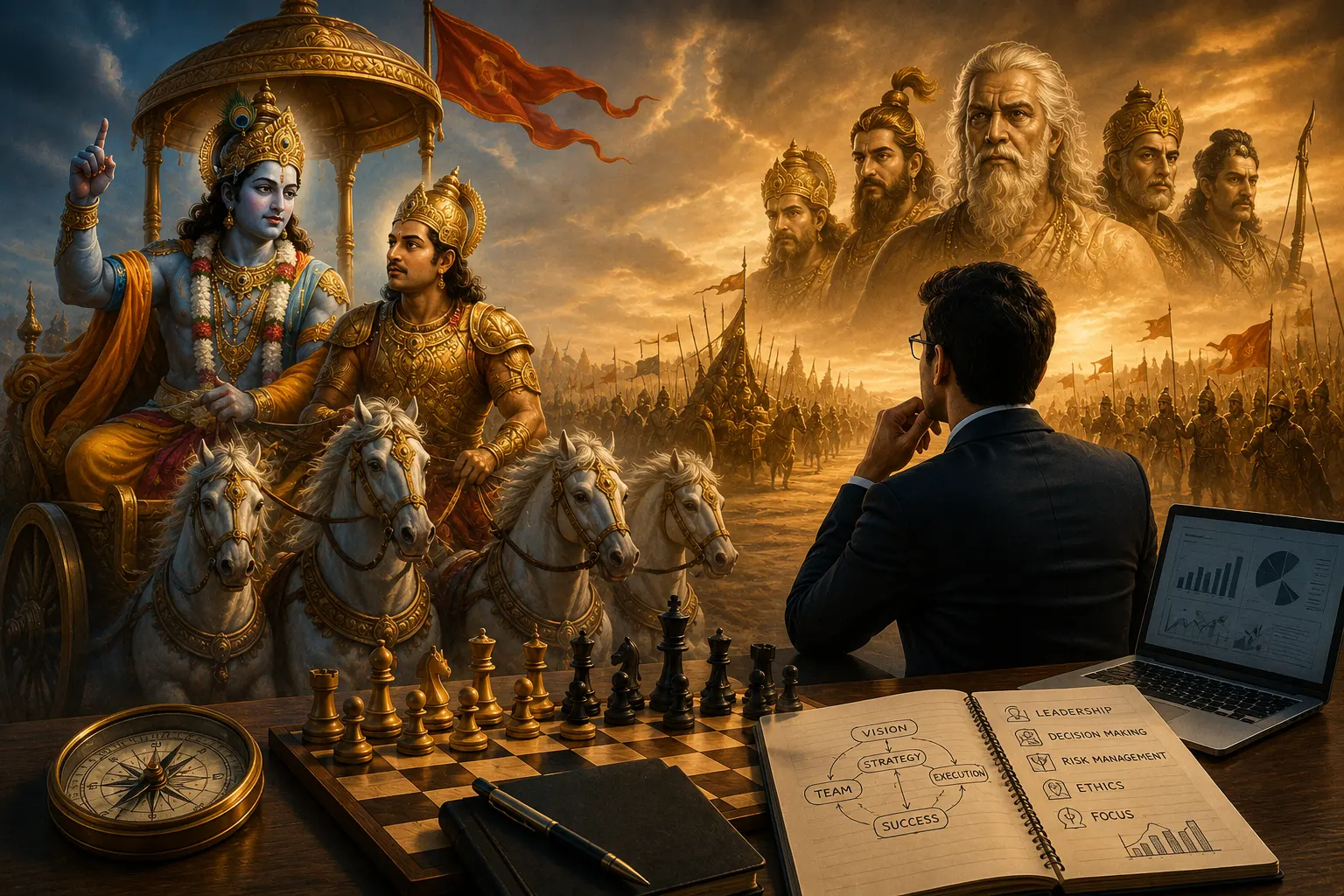
The Mahabharata is far more than an ancient epic. It is one of the world’s greatest studies of leadership, strategy, governance, negotiation, ethics, human psychology, and decision-making under pressure.
Every business owner faces challenges that resemble the dilemmas in the Mahabharata—choosing the right partners, handling office politics, competing ethically, making difficult decisions, managing family businesses, and leading teams through uncertainty.
The characters may belong to another era, but the lessons are timeless.
Here are some practical business lessons from the Mahabharata that every entrepreneur and business leader can apply.
1. Vision Without Execution Is Just an Idea
The Pandavas had a clear vision of establishing a just and prosperous kingdom, but they did not achieve it through wishful thinking.
They planned, prepared, built alliances, developed capabilities, and acted with discipline.
Many entrepreneurs have brilliant ideas.
Very few execute them consistently.
A great business is built through daily execution, not occasional inspiration.
Business Lesson: Ideas create opportunities. Execution creates success.
2. Choose Your Advisors Wisely
Arjuna had Lord Krishna as his guide.
He did not merely receive motivation; he received clarity.
Every business owner needs mentors who challenge assumptions, offer honest feedback, and help make better decisions.
Avoid surrounding yourself only with people who agree with everything you say.
Good advisors reduce costly mistakes.
3. Never Let Ego Drive Business Decisions
Duryodhana lost everything despite having immense resources, a powerful army, and influential allies.
His biggest weakness was not a lack of capability—it was unchecked ego.
In business, ego appears in many forms:
- Ignoring customer feedback
- Rejecting new ideas
- Underestimating competitors
- Refusing to admit mistakes
- Believing success is permanent
Businesses grow when leaders remain humble enough to keep learning.
4. Build Strong Relationships Before You Need Them
The Pandavas invested years in building trust and meaningful relationships.
When difficult times arrived, those relationships became their greatest strength.
Networking is not about collecting business cards.
It is about building genuine trust.
Customers, partners, investors, suppliers, and employees support leaders they believe in.
Relationships built during good times become invaluable during difficult times.
5. Strategy Often Defeats Strength
The Kauravas possessed larger armies and greater resources.
The Pandavas won because they combined strategy, preparation, intelligence, and teamwork.
Many startups outperform larger companies for the same reason.
You do not always need the biggest budget.
You need better thinking.
Competitive advantage comes from smarter execution rather than bigger spending.
6. Every Team Needs Clearly Defined Roles
Each Pandava brought unique strengths.
Yudhishthira provided leadership.
Bhima brought power and determination.
Arjuna delivered exceptional execution.
Nakula and Sahadeva contributed specialized knowledge and discipline.
Successful businesses work the same way.
Not everyone should perform the same role.
The right people in the right positions create extraordinary results.
7. Integrity Builds Long-Term Businesses
Throughout the Mahabharata, trust repeatedly determines who gains lasting respect.
Businesses that compromise ethics for short-term gains often pay a much higher price later.
Integrity means:
- Honest pricing
- Transparent communication
- Fair treatment of employees
- Delivering what you promise
- Accepting responsibility when things go wrong
Trust is one of the most valuable assets any business can own.
8. Preparation Wins Before the Competition Begins
Before the Kurukshetra war, every side invested significant time in preparation.
Business competitions are won long before the product launches.
Preparation includes:
- Understanding customers
- Studying competitors
- Building efficient systems
- Training employees
- Managing finances
The better prepared business usually performs better under pressure.
9. Difficult Decisions Cannot Be Avoided Forever
Yudhishthira constantly faced difficult moral and strategic choices.
Business owners experience similar situations.
Sometimes you must:
- Replace an underperforming employee
- End an unprofitable product
- Say no to a client
- Change business direction
- Invest despite uncertainty
Leadership is measured by the quality of difficult decisions, not easy ones.
10. Focus on What You Can Control
When Arjuna became overwhelmed before the battle, Krishna reminded him to focus on his duty rather than becoming consumed by uncertainty.
Entrepreneurs often waste energy worrying about:
- Competitors
- Economic conditions
- Market rumours
- Customer opinions
- Industry changes
While these factors matter, your greatest influence lies in what you control:
- Product quality
- Customer service
- Team culture
- Innovation
- Daily execution
Consistent action beats constant anxiety.
11. Internal Conflicts Can Destroy Strong Businesses
The Mahabharata reminds us that many battles begin within families and organizations before they reach the outside world.
Family businesses especially must separate personal emotions from professional decisions.
Unresolved internal conflicts lead to:
- Poor communication
- Slow decision-making
- Employee uncertainty
- Customer dissatisfaction
Healthy businesses encourage transparent discussions and timely conflict resolution.
12. Talent Alone Is Not Enough
Karna was among the greatest warriors of his time.
Yet several decisions, loyalties, and circumstances prevented him from achieving the success his abilities deserved.
In business, talent without the right environment, ethics, mentorship, and decision-making often falls short.
Success is created by combining skill with judgment.
13. Keep Learning Throughout Your Journey
The Mahabharata values knowledge, wisdom, and continuous learning.
Markets evolve.
Technology changes.
Customer expectations shift.
Entrepreneurs who stop learning eventually stop growing.
Read books.
Attend workshops.
Listen to customers.
Learn from failures.
The best business owners remain lifelong students.
14. Build a Business That Outlives You
The greatest leaders think beyond their own lifetime.
Instead of building businesses dependent on one individual, create systems that continue delivering value for generations.
Develop:
- Strong leadership teams
- Standard operating procedures
- Company culture
- Succession planning
- Knowledge-sharing systems
A truly successful business should be able to thrive even in the owner’s absence.
15. Success Is Meaningful Only When It Creates Value
The Mahabharata repeatedly asks an important question:
“What is the purpose of power?”
Business owners should ask a similar question:
“What is the purpose of profit?”
Profit is essential.
But profit should enable innovation, create employment, improve customers’ lives, support families, and contribute positively to society.
The most respected companies create value before they create wealth.
The Mahabharata is not merely a story of war—it is a masterclass in leadership, governance, negotiation, ethics, teamwork, strategy, and human behavior.
Every entrepreneur will encounter moments of uncertainty, competition, conflict, failure, and difficult choices.
The lessons of the Mahabharata remind us that lasting success is built not only through intelligence and ambition but also through integrity, preparation, wise counsel, disciplined execution, and the courage to make the right decisions.
In business, victory does not always belong to the strongest.
It belongs to those who think clearly, lead wisely, adapt continuously, and never lose sight of their values.
Centuries may have passed since the Mahabharata was written, but its principles remain remarkably relevant for every modern business owner striving to build a successful and meaningful enterprise.